TinyUSB







Overview

TinyUSB is an open-source cross-platform USB Host/Device stack for embedded systems. It’s designed for memory safety (no dynamic allocation) and thread safety (all interrupts deferred to non-ISR task functions). The stack emphasizes portability, small footprint, and real-time performance across 50+ MCU families.
Sponsors
TinyUSB’s continued development is made possible by its sponsors. If TinyUSB helps your products or projects, consider funding its development on GitHub Sponsors.
Platinum
Adafruit has backed TinyUSB since day one as its founding and sole Platinum sponsor. Buying their products directly funds the project’s development.

Sponsors (QWORD)
No QWORD sponsors yet — be the first!
Backers (DWORD)
No backers yet — be the first!
Supporters (Word)
cee****
Thanks (Byte)
Key Features
Thread-safe: USB interrupts deferred to task context
Memory-safe: No dynamic allocation, all buffers static
Portable: Supports 50+ MCU families
Comprehensive: Includes CDC, HID, MSC, Audio, and Host support
RTOS-friendly: Works with bare metal, FreeRTOS, RT-Thread, and Mynewt
.
├── docs            # Documentation
├── examples        # Examples with make and cmake build system
├── hw
│   ├── bsp         # Supported boards source files
│   └── mcu         # Low level mcu core & peripheral drivers
├── lib             # Sources from 3rd party such as FreeRTOS, FatFs ...
├── src             # All sources files for TinyUSB stack itself.
├── test            # Tests: unit test, fuzzing, hardware test
└── tools           # Files used internally
Getting started
See the online documentation for information about using TinyUSB and how it is implemented.
Check out Getting Started guide for adding TinyUSB to your project or building the examples. If you are new to TinyUSB, we recommend starting with the cdc_msc example. There is a handful of Supported Boards that should work out of the box.
We use GitHub Discussions as our forum. It is a great place to ask questions and advice from the community or to discuss your TinyUSB-based projects.
For bugs and feature requests, please raise an issue and follow the templates there.
See Porting guide for adding support for new MCUs and boards.
Device Stack
Supports multiple device configurations by dynamically changing USB descriptors, low power functions such like suspend, resume, and remote wakeup. The following device classes are supported:
Audio Class 1.0/2.0 (UAC1/UAC2)
Bluetooth Host Controller Interface (BTH HCI)
Communication Device Class (CDC)
Device Firmware Update (DFU): DFU mode (WIP) and Runtime
Human Interface Device (HID): Generic (In & Out), Keyboard, Mouse, Gamepad etc …
Printer class
Mass Storage Class (MSC): with multiple LUNs
Musical Instrument Digital Interface (MIDI)
Media Transfer Protocol (MTP/PTP)
Network with RNDIS, Ethernet Control Model (ECM), Network Control Model (NCM)
Test and Measurement Class (USBTMC)
Video class 1.5 (UVC): work in progress
Vendor-specific class support with generic In & Out endpoints. Can be used with MS OS 2.0 compatible descriptor to load winUSB driver without INF file.
WebUSB with vendor-specific class
If you have a special requirement, usbd_app_driver_get_cb() can be used to write your own class driver without modifying the stack. Here is how the RPi team added their reset interface raspberrypi/pico-sdk#197
Host Stack
Communication Device Class: CDC-ACM
Vendor serial over USB: FTDI, CP210x, CH34x, PL2303
Human Interface Device (HID): Keyboard, Mouse, Generic
Mass Storage Class (MSC)
Musical Instrument Digital Interface (MIDI)
Hub with multiple-level support
Similar to the Device Stack, if you have a special requirement, usbh_app_driver_get_cb() can be used to write your own class driver without modifying the stack.
Power Delivery Stack
Power Delivery 3.0 (PD3.0) with USB Type-C support (WIP)
Super early stage, only for testing purpose
Only support STM32 G4
OS Abstraction layer
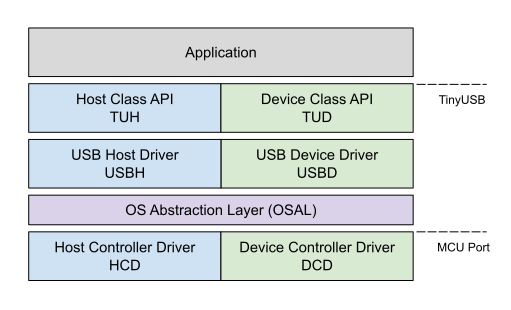
TinyUSB is completely thread-safe by pushing all Interrupt Service Request (ISR) events into a central queue, then processing them later in the non-ISR context task function. It also uses semaphore/mutex to access shared resources such as Communication Device Class (CDC) FIFO. Therefore the stack needs to use some of the OS’s basic APIs. Following OSes are already supported out of the box.
Supported CPUs
Manufacturer |
Family |
Device |
Host |
Highspeed |
Driver |
Note |
|||
|---|---|---|---|---|---|---|---|---|---|
Allwinner |
F1C100s/F1C200s |
✅ |
✅ |
sunxi |
musb variant |
||||
Analog |
MAX3421E |
✅ |
❌ |
max3421 |
via SPI |
||||
MAX32 650, 666, 690, MAX78002 |
✅ |
✅ |
musb |
1-dir ep |
|||||
Artery AT32 |
F403a_407, F413 |
✅ |
stm32_fsdev |
768 USB RAM |
|||||
F415, F435_437, F423, F425, F45x |
✅ |
✅ |
dwc2 |
||||||
F402_F405 |
✅ |
✅ |
✅ |
dwc2 |
F405 is HS |
||||
Bridgetek |
FT90x |
✅ |
✅ |
ft9xx |
1-dir ep |
||||
Broadcom |
BCM2711, BCM2837 |
✅ |
✅ |
dwc2 |
|||||
Dialog |
DA1469x |
✅ |
❌ |
❌ |
da146xx |
||||
Espressif ESP32 |
S2, S3, H4 |
✅ |
✅ |
❌ |
dwc2 |
||||
P4 |
✅ |
✅ |
✅ |
dwc2 |
|||||
S31 |
✅ |
✅ |
✅ |
dwc2 |
|||||
Geehy APM32 |
F072 |
✅ |
❌ |
stm32_fsdev |
1KB USB RAM |
||||
GigaDevice |
GD32VF103 |
✅ |
❌ |
dwc2 |
|||||
HPMicro |
HPM6750 |
✅ |
✅ |
✅ |
ci_hs, ehci |
||||
Infineon |
XMC4500 |
✅ |
✅ |
❌ |
dwc2 |
||||
MicroChip |
SAM |
D11, D21, L21, L22 |
✅ |
❌ |
samd |
||||
D51, E5x |
✅ |
❌ |
samd |
||||||
G55 |
✅ |
❌ |
samg |
1-dir ep |
|||||
E70,S70,V70,V71 |
✅ |
✅ |
samx7x |
1-dir ep |
|||||
PIC |
24 |
✅ |
pic |
ci_fs variant |
|||||
32 mm, mk, mx |
✅ |
pic |
ci_fs variant |
||||||
dsPIC33 |
✅ |
pic |
ci_fs variant |
||||||
32mz |
✅ |
pic32mz |
musb variant |
||||||
MindMotion |
mm32 |
✅ |
❌ |
mm32f327x_otg |
ci_fs variant |
||||
NordicSemi |
nRF52, nRF53 |
✅ |
❌ |
❌ |
nrf5x |
only ep8 is ISO |
|||
nRF54 |
✅ |
❌ |
✅ |
dwc2 |
|||||
Nuvoton |
NUC120 |
✅ |
❌ |
❌ |
nuc120 |
||||
NUC121/NUC125, NUC126 |
✅ |
❌ |
❌ |
nuc121 |
|||||
NUC505 |
✅ |
✅ |
nuc505 |
||||||
NXP |
iMXRT |
RT 10xx, 11xx |
✅ |
✅ |
✅ |
ci_hs, ehci |
|||
Kinetis |
KL, K32L |
✅ |
🟡 |
❌ |
ci_fs |
||||
LPC |
11u, 13, 15 |
✅ |
❌ |
❌ |
lpc_ip3511 |
||||
17, 40 |
✅ |
🟡 |
❌ |
lpc17_40, ohci |
|||||
18, 43 |
✅ |
✅ |
✅ |
ci_hs, ehci |
|||||
51u |
✅ |
❌ |
❌ |
lpc_ip3511 |
|||||
54 |
🟡 |
🟡 |
✅ |
lpc_ip3511, lpc_ip3516 |
NRND [1] |
||||
55 |
✅ |
✅ |
✅ |
lpc_ip3511, lpc_ip3516 |
|||||
MCX |
N9 |
✅ |
✅ |
ci_fs, ci_hs, ehci |
|||||
A15 |
✅ |
ci_fs |
|||||||
RW61x |
✅ |
✅ |
✅ |
ci_hs, ehci |
|||||
Puya |
PY32F071, PY32F072 |
✅ |
❌ |
❌ |
musb |
1-dir ep |
|||
Raspberry Pi |
RP2040, RP2350 |
✅ |
✅ |
❌ |
rp2040, pio_usb |
||||
Renesas |
RX |
63N, 65N, 72N |
✅ |
✅ |
❌ |
rusb2 |
|||
RA |
4M1, 4M3, 6M1 |
✅ |
✅ |
❌ |
rusb2 |
||||
6M5 |
✅ |
✅ |
✅ |
rusb2 |
|||||
Silabs |
EFM32GG12 |
✅ |
❌ |
dwc2 |
|||||
Sony |
CXD56 |
✅ |
❌ |
✅ |
cxd56 |
||||
ST STM32 |
F0, F3, L0, L1, L5, WBx5 |
✅ |
❌ |
❌ |
stm32_fsdev |
||||
F1 |
102, 103 |
✅ |
❌ |
❌ |
stm32_fsdev |
512 USB RAM |
|||
105, 107 |
✅ |
✅ |
❌ |
dwc2 |
|||||
F2, F4, F7, H7, H7RS |
✅ |
✅ |
✅ |
dwc2 |
|||||
C0, C5, G0, H5, U3 |
✅ |
✅ |
❌ |
stm32_fsdev |
2KB USB RAM |
||||
G4 |
✅ |
❌ |
❌ |
stm32_fsdev |
1KB USB RAM |
||||
L4 |
4x2, 4x3 |
✅ |
❌ |
❌ |
stm32_fsdev |
1KB USB RAM |
|||
4x5, 4x6, 4+ |
✅ |
✅ |
❌ |
dwc2 |
|||||
N6 |
✅ |
✅ |
✅ |
dwc2 |
|||||
U0 |
✅ |
❌ |
❌ |
stm32_fsdev |
1KB USB RAM |
||||
U5 |
535, 545 |
✅ |
✅ |
❌ |
stm32_fsdev |
2KB USB RAM |
|||
575, 585 |
✅ |
✅ |
❌ |
dwc2 |
|||||
59x,5Ax,5Fx,5Gx |
✅ |
✅ |
✅ |
dwc2 |
|||||
TI |
MSP430 |
✅ |
❌ |
❌ |
msp430x5xx |
||||
MSP432E4, TM4C123 |
✅ |
❌ |
musb |
||||||
ValentyUSB |
eptri |
✅ |
❌ |
❌ |
eptri |
||||
WCH |
CH32F20x |
🟡 |
✅ |
ch32_usbhs |
ISO data loss [2] |
||||
CH32V20x |
🟡 |
❌ |
stm32_fsdev/ch32_usbfs |
ISO data loss [2] |
|||||
CH32V305, CH32V307 |
🟡 |
✅ |
ch32_usbfs/hs |
ISO data loss [2] |
|||||
CH583/2, CH32V103 |
🟡 |
❌ |
ch32_usbfs |
ISO data loss [2] |
|||||
Table Legend
✅ |
Supported |
🟡 |
Partial support |
❌ |
Not supported by hardware |
[empty] |
Unknown |
Development Tools
The following tools are provided freely to support the development of the TinyUSB project:
IAR Build Tools (CX) Professional IDE and compiler for embedded development.
JetBrains CLion Cross-platform IDE for C and C++ development.
PVS-Studio static analyzer for C, C++, C#, and Java code.